Sunday, August 29, 2010

My Reading List


Today I put together a list of all the books I have read relating to pregnancy, birth, parenting and women's health as part of my La Leche League leader application. I was shocked. I have these and so many more for my clients to borrow that I have collected over the years in my Birth & Parenting library. Here is the list I have read: 
(* La Leche League approved)


PREGNANCY
***************
*CHILD IS BORN, A--Nilsson, Lennart 
*ESSENTIAL EXERCISES FOR THE CHILDBEARING YEAR--Noble, Elizabeth (4th ed.)
*HAVING TWINS--Noble, Elizabeth
When You’re Expecting Twins, Triplets and Quads: Luke and Eberlein
The Secret Life of the Unborn Child: Verny
Nurturing the Unborn Child: Verny
What to Expect When You are Expecting
Pregnant Feelings: Rahima Baldwin
*MAKING LOVE DURING PREGNANCY--Bing, Elisabeth & Libby Colman
*EATING EXPECTANTLY--Swinney, Bridget (rev. ed.)
Protecting Your Baby to Be: Profet
Total Nutrition During Pregnancy: Kamen & Kamen
What Every Pregnant Woman Should Know: Tom Brewer
Maternity Leave: Eileen Casey
Pregnancy Bedrest: Johnston & Krant
Moving Through Pregnancy: Elizabeth Bing
Baby Daddy: Clayton Connolly

BIRTH

*******
*BIRTH REBORN--Odent, Michel (2nd ed.)
*BIRTH YOUR WAY--Kitzinger, Sheila
*ACTIVE BIRTH--Balaskas, Janet
*GENTLE BIRTH CHOICES--Harper, Barbara
*INA MAY'S GUIDE TO CHILDBIRTH--Gaskin, Ina May
Spiritual Midwifery: Ina May Gaskin
Birth Matters: a midwife’s manifesta: Ina May Gaskin
Pushed: Jennifer Block
Visualizations for an Easier Childbirth: Carl Jones
*MIND OVER LABOR--Jones, Carl
Silent Knife: Cohen & Estner
Open Seaso: Cohen
Seasons of Change: Suzanne Arms
*IMMACULATE DECEPTION II--Arms, Suzanne
*OBSTETRIC MYTHS VERSUS RESEARCH REALITIES--Goer, Henci
*THINKING WOMAN'S GUIDE TO A BETTER BIRTH, THE--Goer, Henci
*CHILDBIRTH WITHOUT FEAR--Dick-Read, Grantly
*COMPLETE BOOK OF PREGNANCY AND CHILDBIRTH, THE--Kitzinger, Sheila
*HOMEBIRTH--Kitzinger, Sheila
*SPECIAL DELIVERY--Baldwin, Rahima
The American Way of Birth: Jessica Mitford
A Guide to Effective Care in Pregnancy & Childbirth: Enkin, Keirse, Chalmers
Your Baby, Your Way: Kitzinger
Mamatoto; A Celebration of Birth: The Body Shop
Birth With Out Violence: F. Leboyer
Creating a Joyful Birth Experience: Capacchione & Bardsley
Birthing From Within:
Hypnobirthing: Mongan
Natural Childbirth the Bradley Way: McCutcheon

DOULAS & MIDWIFERY

***********************
*BIRTH PARTNER, THE--Simkin, Penny
A Midwife's Tale: The Life of Martha Ballard
Wise Woman’s Herbal for the Childbearing Year: Susan Weed
Understanding Diagnostic Test in the Childbearing Year: Anne Frye
 
BREASTFEEDING

*****************
*BREASTFEEDING ANSWER BOOK, THE
*IF MY MOM WERE A PLATYPUS--Michels, Dia
*LEADER'S HANDBOOK, THE--LLLI (4th. rev. ed.)
*NURSING MOTHER'S COMPANION, THE--Huggins, Kathleen (6th ed.)
*WOMANLY ART OF BREASTFEEDING--LLLI (7th ed.)

PARENTING

*************
*CONTINUUM CONCEPT, THE--Liedloff, Jean
*HOW TO TALK SO KIDS WILL LISTEN & LISTEN SO KIDS WILL TALK--Faber, Adele & Elaine Mazlish
*HOW YOU WERE BORN--Cole, Joanna (rev. ed.)
*ONCE UPON A POTTY (Boy, Girl)--Frankel, Alona
*RAISING A SON: Parents and the Making of a Healthy Man--Elium, Don, Jeanne Elium
*RAISING YOUR SPIRITED CHILD--Kurcinka, Mary Sheedy
*SIBLINGS WITHOUT RIVALRY--Faber, Adele & Elaine Mazlish
*SOPHIE AND THE NEW BABY--Anholt, Catherine & Laurence
*NONVIOLENT COMMUNICATION: A Companion Workbook--Leu, Lucy
*HOW TO RAISE A HEALTHY CHILD...IN SPITE OF YOUR DOCTOR--Mendelsohn, Robert
*RUNAWAY BUNNY, THE--Brown, Margaret
*YOUR CHILD'S SELF-ESTEEM: The Key to Life--Briggs, Dorothy
*WOMEN AS MOTHERS--Kitzinger, Sheila
What to Expect the First Year
Positive Discipline: Jane Nelsen
Ames & Ilg series Your Two Year Old, ect.
Circumcision, what it Does: Billy Ray Boyd
Say No to Circumcision: Dr. Thomas J. Ritter
The Anguish of Loss: Fritsche & Ilse
Becoming Attached: Robert Karen
A Baby for Grace: Ian Whybrow

HEALTH

**********
*WOMEN'S BODIES, WOMEN'S WISDOM--Northrup, Christiane (2nd ed.)
Wise Woman’s Herbal for the Childbearing Year: Susan Weed
Childbirth & Marriage: Tracy Hotchner
Beyond the Baby Blues: Bennett & Indman
Understanding Diagnostic Test in the Childbearing Year: Anne Frye

Breastfeeding and Kangaroo Care in a Neonatal Intensive Care Unit

I met Jessica when she came to give a talk at an ICAN meeting. Even though this birth was not local I felt her poignant story was so important I asked her if she would be willing to share it on my blog. It is full of many of the issues I have currently been writing about; changing our "plans", creating a partnership between mothers and medical staff, pairing the best of mothering with the best of science so our most vulnerable babies get the best of both worlds, and when is the moment we are reborn into the role of parent. It is of particular interest to me that although Jessica is a Certified Nurse Midwife when it came to her own child she was no different than most first time moms. It took time for her confidence in her mothering abilites to grow enough for her to step into her parental role, stand on her feet and stand up for her son and her rights.

A Nursing Story

Oliver was born under the bright lights of the operating room. At three pounds, seven ounces, he was lucky to be born in 2006. He had a statistically high chance for survival in the neonatal intensive care unit. I was told he cried when he was lifted from my belly and when his delicate little body was subjected to IVs and wires and tubes just moments after birth. The details of Oliver’s birth and my operation were finally made clear to me many months later when I reviewed the operative note. It’s all I have of his birth. But I have Oliver and I am grateful.

Magnesium sulfate kept me from holding my baby for the first 24 hours after his birth. 


(Dad stepped in providing Kangaroo Care, skin-to-skin continuous contact.)


I vaguely remember vomiting, severe headaches, and terrible abdominal pain during that first arduous day. My home birth midwife knew how badly I wanted to have a “normal” childbirth experience and my strong desire to nurse my child. Within the first couple of hours she had procured a hospital grade pump and taught my friends how to pump my breasts. They propped me up every three hours and collected my colostrum until my mother arrived and took over the duty all night (after flying across the country).


The next day I was considered stable and was wheeled to the NICU to meet my son. The NICU nurse carefully handed him to me. He was exactly what I wanted. I felt like I was meeting someone I already knew, his face so familiar yet lovelier than anything I had ever seen. I did what I had seen hundreds of new moms do when holding their babies for the first time. I put him to my breast. The nurse panicked because he was not “cleared” to take anything by mouth. But Oliver’s tiny mouth and weak suckle would have prevented him from nursing anyway at that stage. “We are just bonding,” I explained to the kind nurse. Oliver closed his eyes and breathed in the smell of his mommy. We both relaxed and I knew we would eventually get over his traumatic birth.


Oliver was born at a progressive hospital with an excellent NICU. When I knew I would be delivering him early, I was transferred via ambulance to that particular hospital because I was told it had the best NICU in the state of Connecticut. My husband and I spent hours holding him skin to skin doing “kangaroo care.” Oliver was getting stronger and my bags of breast milk were filling up the small NICU refrigerator. I was so proud of that milk. At every tube feeding the nurses would help me put Oliver to my breast to help him associate my breast with a full belly. Eventually Oliver was strong enough to move to a less intensive care unit. We decided to have him transferred to a smaller NICU closer to our house. I called the nursing manager and was told I would be supported in my desire to do kangaroo care with my child and breastfeed.


We arrived at the small NICU early in the morning on a weekend. I immediately took Oliver out of his isolette for some kangaroo time after the long ambulance ride. After an hour of skin to skin, I was told by the nursing manager to “put him back” because I was making him cold. My husband and I learned that kangaroo care at our new NICU consisted of one hour, once a day. I argued with the nurse and wanted to speak with the pediatrician. I wasn’t able to hold my baby that entire day and evening. I just sat, staring at him though the plastic of his isolette, and cried. I finally cried about everything: the loss of our birth experience, the first precious moments after birth, our special baby moon. It suddenly felt like we were in hell. That night I pumped and noticed a sharp decrease in the amount of milk I was producing. I was concerned so I called my midwife and told her what had happened. She lit a fire under me and gave me the strength to fight for my son. A friend helped me gather articles about the benefits of kangaroo care so I would be armed with information when I met with the pediatrician in the morning.


After a long meeting, the pediatrician agreed to “let” me hold Oliver for one hour, three times a day, as long as his temperature was monitored every fifteen minutes. I agreed because I wanted to show how stable his temperature would be during kangaroo care. The nursing manager stopped speaking to me but I did find compassionate support from many of the nurses. At night, the nurses would “forget” to check on us and I would end up holding him for hours. Slowly, I was able to try to nurse him again at every feeding. I was the only breastfeeding mom at that time in the NICU and the staff had never worked with a mom who was exclusively breastfeeding at discharge. My midwife came to the NICU to show the nurses how to use a supplemental nursing system and how to position a small baby correctly. With her help I was finally able to get Oliver firmly latched on during a feeding.


The last four days of Oliver’s stay at the NICU were the most difficult, but necessary to establish a breastfeeding relationship. I convinced the pediatrician to let me sleep at the hospital. The NICU nurses set up a cot for me near the unit so I could be available to nurse Oliver every few hours. By the time I put Oliver in his car seat to leave the hospital, he was 100 percent breastfeeding. It is my most important accomplishment.. I send the NICU nurses a Christmas card every year to remind them of sweet little Oliver and this annoying mom who made it her mission to breastfeed and succeeded!

Next read about a "miracle" baby and the chemical, biological, and emotional power of a mother's love. http://www.dailymail.co.uk/health/article-1306283/Miracle-premature-baby-declared-dead-doctors-revived-mothers-touch.html

Saturday, August 28, 2010

Being a Hospital Doula: My Greatest Challenge

Sometimes I can only bear witness. I am helpless to ward off the blow. I educate. I put a "game plan" in place. I manage. I guide. I manipulate the system. I encourage. I remind women they have a voice; they have a choice. But in the end sometimes I am powerless to protect. My role is to stand and bear witness to the birth unfolding before my eyes. My heart breaks; little pieces crumbling away. Bits of me I will never get back. Moments in my life I will never forget. I hold on to the belief, for her and for me, that grief is transformational if we let it be.

Friday, August 27, 2010

Home Birth... Why I Did It (& I'm Not a Hippie)

Not sure about where to birth, hospital or home? When trying to decide where to birth I always advise my clients to look deep into their hearts and listen to what it is telling them. Where will you feel safest? For some moms that is the hospital and for others it is at home.

Recently I had a client who was preparing for the birth of her second child. She was having a difficult time deciding between Sierra Vista or French Hospitals. She had a lot of negative feelings about her first birth but was choosing to return to the same hospital, even though she dreaded it, because of fears about safety issues for her baby. Her heart was conflicted. I encouraged her to listen to her heart and decide. She planned to return to the hospital of her first birth. That was the plan. It was all settled. Everyone knew that was the plan . . . until she was on the way to the hospital. Then her heart spoke to her again and said, "you have nothing to fear for your baby. She is fine and healthy. Go to the hospital where you think you can labor best." And that is what she did. She changed her plan.

Read one Illinois mom's thoughts about making her choice posted August 4, 2010 on Ireport at CNN.com

I gave birth to my son at home.

And no, I’m not a hippie. I’m a college educated, business minded woman who made an informed choice about the labor and delivery of my second child.

Giuseppe Massimo “Max” entered this world at 11:46 pm on March 4th, 2010 in our bedroom of our Northbrook, IL home. I wouldn’t change a thing about the labor and delivery. It was one of the most incredible moments a family can have. I’d like to tell you a little more about what led up to that special moment.

When my husband and I first learned I was pregnant a second time, We weren’t even considering a natural birth, let alone a home birth. My first child was born in the hospital, I had been given an epidural, and I just assumed I’d do the same for the second. A few months later I learned that one of our neighbors had delivered all three of her children at home. I’m sad to say that my first reaction was “why in the world would anyone ever want to do that??” But something kept creeping up in my mind, I was truly intrigued by the idea. A few weeks later I talked with a friend who had done a natural birth. I’ll never forget the day when we met over coffee and I heard her birth story and the emotions she had around her natural childbirth. I was amazed by her story and yet sad when I realized my feelings about my first birth were nowhere near that happy, passionate or memorable. Don’t get me wrong, I love my daughter dearly, but her birth was not as I had always envisioned. I then started to open my mind about the idea of natural childbirth and began doing some detailed research. What I found both elated and saddened me. I was thrilled to learn about all of the wonderful benefits for both mom and baby when childbirth is left to naturally run its course. But I felt so dismayed that the majority of women are never exposed to this information. They don’t really know they have a choice. Society puts so much pressure on them to have a fast labor, make sure it’s painless, and get in and out of the hospital quickly. There are so few natural birth advocates out there, likely because hardly anyone is doing it as its not likely to be covered by insurance or endorsed by your OB/GYN. Plus there’s a stigma. As I mentioned, I’m not a hippie, but everyone assumes you are some free lovin’, incense-burning, crazy lady that has no regard for her or her unborn’s health when you tell them you are having a home birth. The reality is that for healthy women with no pregnancy complications, natural childbirth is much safer and healthier for both mom and child (when the birth is attended by a certified midwife). If you think about it, people go to hospitals because they are sick, childbirth is the only thing they go there for that is a completely natural process. Why is that? Well, it all has to do with the mighty dollar. It’s a big business and insurance companies and doctors solve for the riskiest cases, and then apply that logic and methodology for all. Patients assume this is best, but its simply not. History has shown this time and time again.

I encourage you to do your own research on childbirth, but I’ll give you a bit of the basic info that I’ve learned over the last year. There’s more to childbirth then simply getting the baby out. A complex chain of events occurs with the mom and baby as labor and delivery progress. When left untouched, natural hormones enter the mother and baby that make the birth easier for both and also create a stronger bond with mom and baby. Natural birth babies are more responsive and much more likely to successfully breastfeed. Passage through the birth canal helps squeeze all of the fluids out of the baby’s lungs enabling better breathing after birth. The benefits of natural birth go on and on, all leading to a happier, healthier baby and mom.

So, why at home then? Sure you can have a natural birth in the hospital, right? Not always. You may go in with a birth plan, but hospitals have their own agendas. They minimize the risk and get you out quickly so they can get a new mom in. With 1/3, yes ONE THIRD of women in the US now having c-sections, I didn’t want to take my chances. The rate was under 5% in 1965 when hospitals began to keep track of the numbers. Now it’s over 30%! What happened? Well it’s not that women are smaller, or babies are that much bigger, it’s now a matter of convenience. But not for the mom, its for the hospital, doctors and insurance companies. C-section rates are actually highest at 5 pm and 10 pm. Why? So doctors can get the birth over with and get home for dinner or bed. They can opt for the c-section and be out of the hospital on their way home in less than 30 minutes. And at that point, weary moms are likely not to argue. You simply assume the doctor knows best.

I’m guessing that even with my natural birth plan, if I had been in the hospital I would have ended up with Pitocin (drug used to speed up labor, but reduces the mom’s natural birth hormones) and likely a c-section. At home it took me 30 hours to labor Max down. And at 9 lbs, it took me over an hour of pushing. Likely not something a doctor would have the patience to wait out. But my midwife stayed calm and relaxed, she knew the baby would eventually emerge. She was a great coach and I felt confident she had the experience to handle any situation. This is important to note, as I don't believe in unattended home births. A home birth should always have an experienced midwife present.

And sure, it was painful, REALLY painful. But the instant my son was born, I felt 100 times better than I did with my first baby. My connection with him was instant and he immediately latched on to breastfeed. My husband also enjoyed the experience much more at home. First, he always wondered why I didn’t seem to show a strong connection with my daughter when she was first born. With Max he was in awe of the immediate deep bond. Additionally, he was able to really participate. He was able to help much more at home and actually catch the baby as he emerged. Plus, we all got to sleep in our own bed that night. We wouldn’t trade the entire experience for the world.

My hope is that by sharing my story, I may encourage at least one mom to do her own research so she can make the best decision for her childbirth experience. Women need to start reclaiming their baby’s births. I’m certain almost all women are capable of a natural birth, and if they take back that right, we will have healthier and happier moms, dads and babies out there.

What speaks to your heart? Where will you feel safest?

Thursday, August 26, 2010

Breech Birth: Turning Her Plans Upside Down!


This is the story of Zoe's birth at French Hospital in 2009 and a mother's difficult decision to let go of her vision of the birth and growing into acceptance of a scheduled cesarean birth.

For me, there was no better choice than to have my baby naturally, no drugs and as few interventions as possible. That was the plan. But as most women who have a baby, ‘the plan’ is rarely followed. You can prepare for birth but not plan, I know that now.

My husband and I decided knowledge was the best tool to being prepared for our daughter’s arrival. So we took a very extensive, thorough birthing class. We learned about nutrition, the history of birth, birthing options, physiology of birth, pain management, interventions, and the newborn. These classes made me feel positive, ready and prepared.

I wasn’t entirely comfortable with a home birth. I would have loved to have a birthing center, but that option did not exist, so we opted for a hospital birth. Because of this, we felt hiring a doula was even more important for ‘game day’. Our doula was someone we felt could help us navigate the decisions we inevitably would have to make but did not know what they would be yet.

Week 36 of pregnancy rolled around and I was feeling ready, prepared, but anxious about all the unknowns. We were about to run into our first big ‘unknown’. We went to my weekly doctor’s appointment and as my doctor felt my baby bump, she decided she was no longer convinced that what she thought was the baby’s bottom, up by my ribs, was in fact her bottom. Yep, this baby was breech. What does this mean? What do I do now? What are my options? Could this have been determined earlier?

For the next two weeks, I dropped everything else in my life and put all my energy into trying to convince my breech baby to turn. I researched breech babies and the possibility of having a breech baby vaginally and decided that was not an option for me. So I set out to try to convince my baby to turn. I was in the breech tilt for most of the week. I took warm baths and put cold peas at the top of my belly. She moved, she didn’t like the cold on her head, but she didn’t turn. I did acupuncture and worked on relaxation. I tried a homeopath from my chiropractor. I did hand stands in the pool. All of this encouraged movement, but not turning. My last attempt was a manual version, where the doctor tries to manually turn the baby. Nope, this baby was set in her ways and was going to stay breech.

For a while I felt defeated that I could not get my baby to turn. This was just another piece of evidence that birthing stories are not in our control. I had about 2 weeks to process the fact I’d be having a c-section, I was thankful for that time. After all this time of preparing myself to NOT be in control (which is hard for me, but I was ready to just give myself over the process), all of a sudden I was picking my baby’s birthday and working around ER and doctor schedules. It felt weird, wrong, and inorganic. Luckily I have a very supportive husband, family and friends who helped me process this very drastic change of events. I had one friend list all the things to look forward to with a c-section (some silly, some serious).

When December 18th finally came, we had an appointment to have our baby. I never really got past the fact that in was really weird to schedule a birth, but the excitement of being able to meet my baby overtook any lingering disappointment I may have had. The c-section was flawless and in a moment, a scheduled moment, I became a mother, we became a family. At that point, I didn’t care how Zoe arrived, because she arrived safely and was healthy. I was able to have her with me in the recovery room and she nursed within a ½ hour of being born. It wasn’t the birth I planned for, but it was the birth that we got, and that is a-ok with me.

To me the moment Zoe's mom became a mother was when she chose to do what she felt was right for her baby and put aside her dreams for herself.

Wednesday, August 25, 2010

Rewriting Her Experience

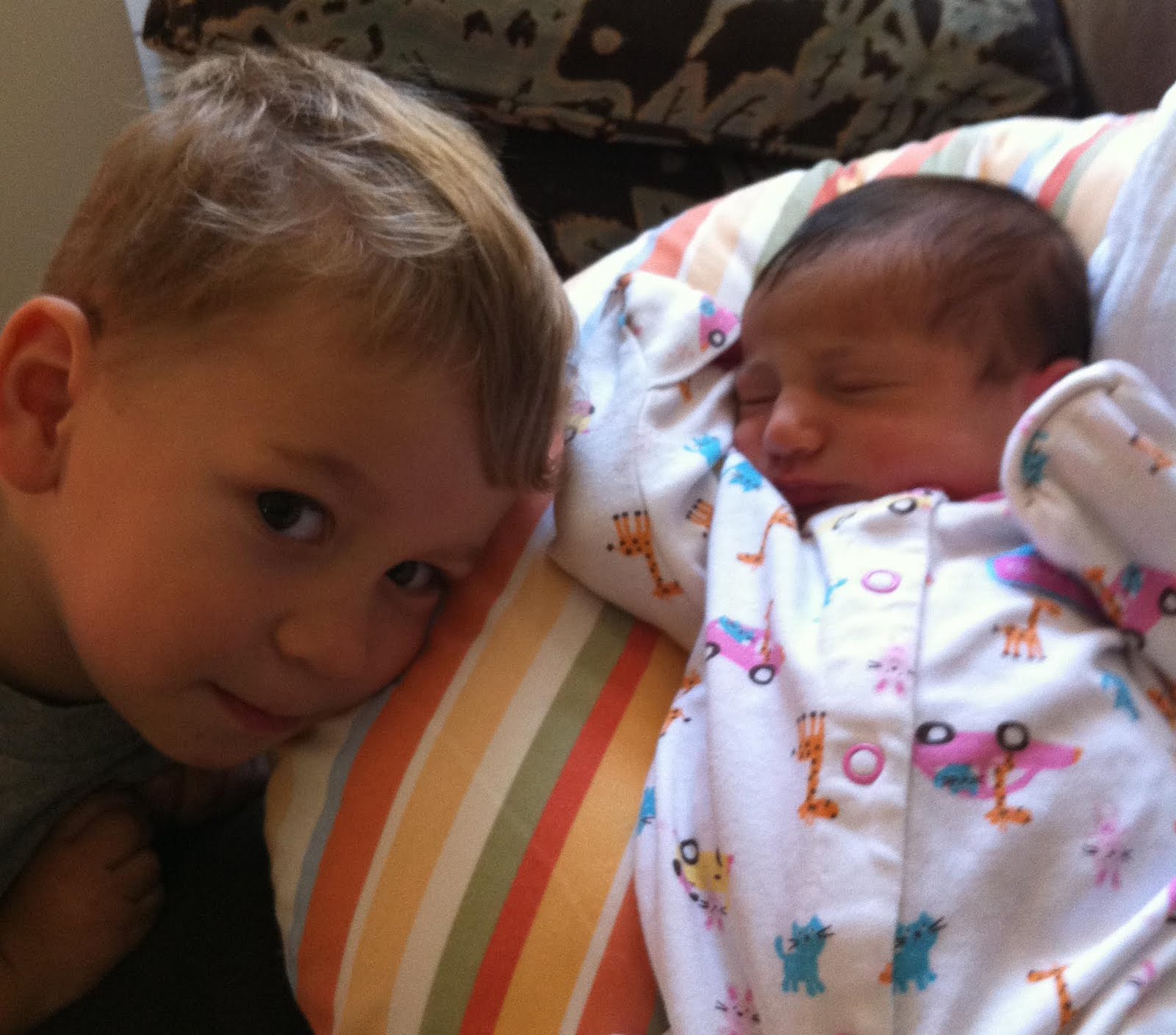
New big brother Lincoln thinks his new baby sister is pretty special. I think she is too. She taught her mom what a high it is to birth naturally. Often the power of preparation, positive thinking and a second baby combine to transform feelings of regret or inadequancy left over from a first birth experience into jubilation, awe and empowerment. Congratulations!

A huge thank you to Trina Dart who was my back up doula for this birth. She stepped in when I couldn't and provided excellent support and care. She made a world of difference during the birth.

Friday, August 20, 2010

You Don't Know How Lucky You Are

I don't believe the birthing women of San Luis Obispo have a clue how lucky they are. Even many of the women working in our birth community don't know how lucky we are. We are so busy being in the here and now of our little corner of the world we assume this is how it has always been, this is how it is everywhere. Those of us working in the "alternative" birth community often see only the negatives. Guess what? Your perception is wrong. There are so many positives going on every day in our community. There is constant movement toward making births better for all women and their babies.

This was brought home to me in a very powerful and personal way the first time I attended a birth outside of our community. Being with my sister-in-law as she birthed at a hospital in Berkeley was an eye opening experience. A few years later attending another sister-in-law in Nevada taught me to treasure our hospitals and the people working in them. I can't tell you how grateful I am to be working as a doula in SLO.

So let's focus on the positives please! Here is a list:

Twenty years ago when I had my son if your baby was born in need of serious medical attention he was flown by helicopter to Stanford. Moms, dads and babies were separated until the mom was recovered enough from the birth to drive up to the Bay Area. Then the staff at Sierra Vista got together and created our local NICU. This was a huge project which now benefits women, babies and families in our community every day. Now if you are a high risk mom or have a high risk baby you have a place to go close to home and the support of family and friends.

When it became clear to everyone that General Hospital was probably going to no longer be funded by the county French Hospital stepped up to fill the gap. General had always been the low-tech family friendly hospital. French Hospital with it's small size and supportive staff is an excellent hospital for women going for a less medicalized birth approach.

Not too many years ago the best we could do for using water as a pain relief method was a shower. Now we have labor tubs at all three county hospitals where women can seek pain relief without the use of narcotics and needles. Want to birth in water? You can rent a tub and birth at home with one of our skilled homebirth midwives.

Fifteen years ago when a friend needed a specialized ultrasound done to check out the chambers of her baby's heart she had to travel to the Bay Area. Now for women who need specialized monitoring of their pregnancy we have qualified perinatologists with ultrasound capabilities far beyond what we once had.

We have lots of OB doctors with lots of different personalities and philosophies and styles to choose from. If you want to use a midwife instead we have an ever growing choice. There is something for every woman on the menu. Want to birth in the hospital but with a midwife? Guess what? We currently have two different certified midwifery groups working with two different doctors. Don't want to go to the hospital? We have two different licensed midwives to choose from and by this time next year we should have several new midwives joining their ranks.

Don't feel comfortable either birthing at home or in the hospital? Guess what? We have an out-of-hospital birth center currently under construction. It is due to be open for women with December due dates. Watch their progress on facebook.

I remember when your only choice for birth education was to take Lamaze at the hospital or Bradley outside the hospital. Now you can choose from these as well as Informed Birth & Parenting, Hypnobirthing, Birth Works or Birthing from Within. There is something for everyone from over the grade to the south county.

We have many other support groups and professionals for new parents in our area. Need free breastfeeding help? Call the Warm Line at 541-BABY. Want a breastfeeding support group? Try our local La Leche League meetings. Speaking of breastfeeding; we have excellent lactation consultants working in and out of our hospitals. Need postpartum support and counseling? Call the Postpartum Hot line at 549-7786. Need a shoulder to cry on about a negative birth experience? Go to one of our ICAN meetings. We have mommy support networks both on line and in person such as SLO County Mommies. We have parenting classes through Parent Participation throughout the county or Andrea Herron's Growing with Baby.

Considering using a doula at your birth? Go to the resource guide at the Birth & Baby Resource Network: wwwbbrn.org. We have a whole list of doulas working in the community and new ones getting trained all the time. The perfect match to your personality and belief system is just waiting for you.

As a doula these last items are the most important to me.

When the American College of Obstetricians and Gynecologists created new rules which required anesthesiologists standing by for a woman to be "allowed" to go for a vaginal birth after a previous c-section Sierra Vista stepped up and did what was necessary to make that happen for our community. Guess what? We have the only hospital for hundreds of miles that will do v-bacs. I recently had a client who moved back here from Santa Barbara just to be able to successfully v-bac!

Need a c-section? Our hospitals are actively working to create them to be as family friendly as possible given their staffing and geography restraints. They are trying to keep moms, dads, and babies together as much as possible. And guess what? Usually your doula, as well as your husband, can be with you during the entire process.

Last I would like to speak about the relationships with the hospital staff and doulas in our community. It has been many years since I was introduced at a birth as a doula and felt open hostility from the nurses. Now the staff has grown in their understanding and acceptance of the value of doulas within the hospital setting so much that I have even been paired with new nurses so they could be part of a "natural" birth. I would like to also say that anytime I have had doula clients with special needs or situations in preparing for their births both Marie Chaney, Maternal Child Assistant Director, at Sierra Vista and Charley Ault, OB Nurse Manager, at French took the time to speak with them and did their best to accommodate their needs and desires.

So within SLO town the picture looks pretty rosy but step outside this box and the picture gets ugly fast. There are hospitals that won't "allow" doulas to be present at births. They also don't "allow" birth plans or want couples who have taken classes which encourage natural unmedicated births. As a doula I have run into open hostility, been excluded from c-sections, had my client's pre-arranged wishes for their births ignored and witnessed verbal disrespect bordering on abuse of a mom preparing for a cesarean birth.

So thank you to all the women over the years who have tried to make this community more mother/baby friendly. A mountain of sand can be moved one grain at a time.


To read more about life outside our bubble go to A Sign on the Door.

Wednesday, August 18, 2010

Fascinating Video on Initiating Breastfeeding

This is a must see by all pregnant moms, their partners and anyone who will be helping them at their birth. Of course we can crawl to the nipple, latch on and nurse! It only makes sense. All mammals can do this with minimal guidance or help by mom. Why would we be the only mammal unable to do this? It only makes sense. If we birthed in a squatting position we would naturally reach down put our hands under their little armpits and bring them up to our breasts keeping their spine parallel to our own. Without towels or blankets they are much to wet and slippery to consider doing anything else.

How did mothers lose this knowledge of what to do immediately after birth to correctly begin the bonding and breastfeeding process? Drugs, doctors, fear of germs, bright lights, cold hospital rooms and schedules all played a role. You have the power to reclaim this piece of your birth and be amazed at the miraculous abilities of your newborn. Put your baby's spine in line with your own. It is as simple as that. Don't forget to cover, not swaddle, your baby with a warm blanket!

Click on the title to watch the video.

Friday, August 13, 2010

Why Does Birth Feel Like This?

I found a beautiful quote posted on Denver Doula's Facebook page.

"As mothers we must learn to be flexible, for the rigid tree breaks in the windstorms of life. In birth we are utterly taken apart. In this way God guarantees that we emerge anew. This is how Mother Nature builds a new mother, by first burning down our pre-existing lives. The survival of this precious being you hold close today depends upon your undoing."
-Robin Lim via Harmony Miller

No truer statement can be said about birth. Letting go of our bodies, our preconcieved ideas and our inhibitions is essential to the process. Not just the birth process but the process of mothering itself.

Keeper of The Space

This is posted for all my doula friends and other women who provide sacred space for birth.

Keeper of the Space
by Michelle Fonte, Birth Doula

she…on elbows and knees on the bathroom floor
naked body glistening with the evidence of her exertion
brow wet
dad poised behind her
hands ready to catch
abundant curiosity and bliss on his face
she…hands grasping mine. holding. tight
me… mirroring her pose: knees and elbows on the cold floor
her forehead on my shoulder. pressing hard when the surges are strong
i meet her force with equal force
a break.
a pause
i shift my weight
she feels me
eyes raise and meet
intensity
she says ‘don’t leave me’
‘i won’t’
i say
she feels the truth in my answer. again rests her head on my shoulder.
“don’t leave me” she said.
her words turn over in my mind and stroke my ego
wrap around my shoulders like a warm blanket
for a split second. i. feel. Important.
she grunts and groans and sings
looking under her body
between her thighs I see her baby’s head filling up her. blossoming. pink.
intensity of these universes colliding: the one baby has inhabited for 40 weeks and the one he is about to enter
makes her think she may come apart
in this moment. she believes that she needs me
with courage and power and will she perhaps didn’t know she possessed, she births her baby into his daddy’s hands
the midwives say…’mama…take your baby’
she. stunned. still between worlds.
cannot
reaching under i receive their slippery blueish-turning-pink child
daddy’s eyes meet mine.
joy
i passing the gorgeous baby into her hands
eyes raise and meet again
i am humbled
she knows
her power
i remember
i am not important
simply the keeper of the space

Michelle is the mama of six children, doula and birth activist. She currently lives in Miami, Florida.
www.birthgirlz.com


www.motherpathdoulamiami.com


Thank you to Womb Space, a page dedicated to spreading information on childbirth through essays, pictures, articles, videos, poetry and more. http://wombspace.tumblr.com/post/947981510/keeper-of-the-space-michelle-fonte-birth-doula

Thursday, August 12, 2010

Baby Comes in a Rush!

This is the birth story of my second child born Feb. 2, 2010 at Twin Cities Hospital.

I loved being pregnant; (almost) everything about it. I had rather easy pregnancies compared to some that I've heard of before. I thank the Lord for that! Never got sick, although I did have some complications early on in this pregnancy and was advised to quit my housekeeping jobs. I was just over doing it. Had horrible pains one night, cramping, and some very heavy bleeding. I went into panic mode, expecting the worst. Spoke with the Dr. on call, went in for an emergency ultrasound early the next morning and discovered that everything was fine. Again, Thank you Lord!

Months later, we passed the due date of Jan 26th, patiently waiting for that moment. I was having contractions for about 2-3 weeks here and there, having a lot of "not sure if this is it moments" then finally, decided, since my Dr. suggested it, to have my membranes stripped. Not as painful as I thought it would be. Then that night, odd, right at 12:00AM , I woke up from just dozing off it seemed, to a light "pop" sound. Now, my water never broke with my first, they had to break it for me, so this was new to me. Even after hearing that, I just still wasn't sure if "this was it". I raised up in bed, stepped out of bed and felt a slight wetness, but again, I wasn't sure because this little guy had been SUPER low for a while now and I was loosing bladder control a lot, so I first thought, maybe he's putting enough pressure on me down there that I just trickled and didn't make it to the bathroom to pee.

Shortly after that though, I began having contractions and again, I still was not yet convinced that "this was it". My husband woke because he heard me pacing and breathing. I remember telling him, I'm just not sure if this is it or not, I'm not sure if you need to get out of bed yet. However, the contractions were coming a lot harder, painful, and more regular, & rather quickly. I finally told myself, ok, if this isn't it, I'm going to be upset because this hurts! I told my husband that I thought my water broke, but I wasn't sure. I was still trickling though, staying sort of wet.

Hubby decided to get up, saying that "well, we need to go to the hospital but let me brew a pot of coffee first". LOL. Taking our time, all the while they were getting more painful, I finally knew, this is it! I live about 10 minutes from Twin Cities Community Hospital. Thank goodness! We arrived at the hospital at 12:55AM. My pants were definitely wet at this point.

Now I had preregistered, but what the point of that was I have no idea. I get in there, they put me in the triage room, check me, I was 4cm dilated. They said, we'll get you checked in. I said, ok, I do want an epidural this time around. They said ok. He lives just around the corner and we'll get him here when we get you all checked in. Ok great. I was really looking forward to that this time. Things just don't always go as planned, not even for the nurses!
I was hurting, badly, feeling the urge to push like crazy. Telling them, I need it now, come on with it! I remember looking at this nurse, saying, I'm really not a mean person okay! They all still kept taking their time, getting me checked in, etc. Not sure what the hold up was. I just knew it was time to push. I was ready, breathing hard, trying to get through each contraction which at this point was back to back, barely a break at all. I was beginning to think they didn't know what they were doing and that maybe I should of been doing this on my own, because really, I was. My husband just stared at me telling me no, don't push yet.

Finally, still not checked in, another nurse comes to check and see how far I am, keep in mind, only about 15-20 mins had gone by since I got there. I was at 8cm. and there was blood, I was ready. Suddenly I saw the panic in their faces a bit, scurrying around, rushing a bit more now, saying get the Dr. it's time. I asked for an epidural yet again, they said, "oh honey, it's to late for that." I was mad because I was trying to tell them, I needed to push, why don't they listen!?! I'm still in the triage room when the Dr. comes in no scrubs or nothing, saying she hopes for nothing to get on her shoes. I remember thinking, woman, I don't care about your shoes! My husband refers to the bed as a "transformer bed" as quickly as they got this thing ready for what was about to happen!

I was so worried about tearing because I did with my first and that is what I remember most about my first delivery because when I went to pee afterwards, the best way to describe it was like "peeing razor blades", I did not want that to happen again! That is what I was terrified most of! But, one big long push, (and feeling some poop come out as well, eww, embarrassing, but I knew the doctor had seen it before), there he was! It was 1:38AM, I had arrived at the hospital at 5 minutes to 1:00 and he was born at 1:38. Even they were shocked and surprised at how quickly he came. And I didn't tear! YEAH!
7pounds 8ounces. 20in long. Baby Boy Landon. Feb 2, 2010.

(Jennifer-one hour 38 minutes from start to finish! What a mad rush this birth must have been. These fast births take every one's breath away. Often the hospital staff is caught off guard because they have many first time moms come in thinking they are far into labor when they aren't. I never doubt a second time birther. If they say the baby is coming or they have to push you better believe them! I don't know why the OB staff still disbelieves the mom until they prove it to themselves via a vaginal check.)
Now during the stay at the hospital, they informed me that they were going to do a drug test on me and the baby because of how quickly he was born. They said they had seen it where people place bets on when the baby is going to be born and so they'll win, they drug induce labor. I was shocked, blown away at what I had just heard. Wow.

A while later, I did get the medical bill and I called and got an itemized detail of the charges of my stay, on that list was about 8 lab tests they had done for testing for 8 different drugs. Each one costing $200-$500. I think it was about $2800+ worth of tests. Crazy! I called and disputed it, saying, you didn't ask me for these tests, you took it upon yourself and said that it's hospital protocol that you do it, so I don't feel like I should have to pay for this (we did have insurance, but still). They, without question, took all 8 off of the bill. Very interesting I thought.

(Jennifer-I have never heard of this before.)
So, you'd think as fast as that was, my birth story would be shorter. LOL. But here I am, blessed with 2 beautiful boys! Both naturally. Even though I had planned on having an epidural the second time around, it just didn't happen that way. Someone else had a different plan and I just took a deep breath and said ok, here we go. I CAN DO THIS! That was that! Now my husband and I are all done. Two kids is enough for us. Especially 2 boys with my husbands blood running through them! LOL.

Jackie

(I e-mailed Jackie to ask her how far past her due date she was when the doctor first suggested she have her membranes stripped.)

Jackie wrote:
"Let's see, I was 1 week past. My Doctor had actually mentioned it to me before. I was 3 cm dilated for a couple of weeks. After he was born, the nurse said, I was even further along than the due date they had given me as well. "

(Goodness a good doula would know that any second time mom who has been hanging out at 3 centimeters for a couple of weeks and then goes into strong back to back contractions is going to move very quickly! As to due dates, don't even get me started. They are notorious for being off regardless of ultrasound technology. After babies are born the nurse does an assessment to try to guesstimate how developed your baby is, which helps them know how many weeks gestation actually occurred before the baby was born.)

Thursday, July 22, 2010

New Guidelines Aim to Reduce Repeated C-Sections

Great reporting on an important birth issue by someone in the mainstream media! This reporter does an excellent job of thoroughly explaining the complexities of the issues surrounding giving women back the right to make their own choice to try for a vaginal birth after a previous cesarean or to go with a repeat surgical birth.

But before you read it let's put it into historical, local, political, and a doula's context.

When I was in my twenties the cesarean rate was rising. Like my sister-in-law most of these women were being sectioned the first time for something called cephalopelvic disproportion. This means the baby's head (cephalo) is too big (disproportion) to fit through mom's passageway (pelvic). How did they figure this out? Two ways. One was a labor that wasn't progressing at the rate of speed the medical community agreed was normal at that time. I say "at that time" because I have worked with plenty of local doctors who no longer practice with this older time frame model in mind. Or before she ever began labor they might xray the mom , take measurements and make a determination without even a trial of labor. Of course this practice has now been abandoned. Xraying moms; it sounds crazy doesn't it? Guess what! We still routinely ultrasound moms who have gone past their due date and one of the things the doctor does is make a recommendation to your OB or midwife about the possible size of your baby and whether you should be sectioned for...wait for it...here it comes...cephalopelvic disproportion or possible shoulder dystocia (shoulders to big to fit) before you even try!

The second reason women were being operated on to give birth was the fact that they had been operated on to give birth. This was the era of "once a cesarean, always a cesarean". The surgical technique of the time was to cut the mom vertically from below the ribs to the pubic bone. This classical cut was associated with a high rate of rupture during future labors. The ghost of this fear based on the rupture rate of classical incisions is still with us today in the doctor's office when women discuss their "options" for future births. It is still in women's hearts too, passed down to them from their mother's birth era.

When I was in my thirties things were changing. The medical community had realized the cesarean rate was sky rocketing and they needed to do something about it. Surgical technique for incisions and suturing had changed; the "bikini cut" had come into vogue, and the risk of rupture had been significantly reduced. Also consumers had put pressure on the medical establishment by taking matters into their own hands; either birthing out of hospitals all together to achieve their V-BAC, or going into the hospital late in labor and refusing to undergo a repeat surgery. Doulas were being asked to labor sit at home with these moms and try to bring them to the hospital at the last moment. These brave pioneers proved women could safely and successfully labor and birth vaginally after a previous surgical birth. They proved V-BAC was a viable option for many women. I remember Dr. Clutter and Dr. Lickness being our first local doctors to support women in this choice.

When I was in my late thirties it was the norm to at least go through a "trial of labor" before deciding to section a woman again. Some of our doctors were much more liberal in their "trials" than other local doctors. As a doula I often felt I had to match wits with some of our more scalpel ready doctors to keep my clients out of the operating room. Another positive change was our local certified nurse midwives being allowed by their supervising doctors to V-BAC women in all our hospitals. Sandy Rodriguez and JoAnne Tarkington caught many, many a successful V-BAC baby.

By my forties the pendulum was swinging back. The fear of uterine rupture was again haunting doctors' offices and labor rooms. A study came out showing that V-BAC women had a greater chance of rupturing than nonV-BAC women. This study lumped all women together without taking into account if the mom went into labor on her own or if she was induced. It also didn't make any distinction as to the method used for induction. (Remember that wonderful induction drug Cytotec? This is the era it is becoming more popular among the medical community. Don't know about Cytotec? Read my piece, Let's Talk about Off Label Use, Cytotec and You.) In reponse to the study the American College of Obstetricians and Gynecologists (ACOG) came out with guidelines requiring hospitals to have anesthesiologists waiting in the hospital the entire time a V-BAC mom labored. Most hospitals found this a financial, practical, legal and bureaucratic impossibility. For a brief time all V-BACs were shut down at our hospitals. Luckily for us Sierra Vista took the bold step of contracting with our local anesthesiologists for enough coverage to allow Sierra Vista to offer the V-BAC option to women in our community. But it is the only hospital within hundreds of miles to do so! I recently had a client who moved back from Santa Barbara to Atascadero just so she could successfully V-BAC at Sierra. ACOGs guidelines also required OBs to be standing by throughout potentially long labors. For many doctors' practices this was a practical, geographic, and financial impossibility. So if your OB's office was located physically close enough to Sierra Vista you could V-BAC, if not you could not. And of course our wonderful nurse midwives were no longer "skilled" enough to catch V-BAC babies. I will never forget the last V-BAC I was at with Sandy and JoAnn. My client had been told she could V-BAC with them but when she was in labor in the hospital she was told the supervising doctors could no longer advise she go for a vaginal birth because she was past her due date. My client decided to refuse to say yes to another surgery. Sandy supported her decision and JoAnn did a great job catching a beautiful healthy baby girl. I have never been more proud of three women in my life. Meanwhile women continue to safely V-BAC with our licensed midwives at home and with doctors at Sierra Vista every day.

When I was fifty I was hired as a doula by a woman who was trying to find some way to not end up with a second operative birth. She was caught in a terrible bind. Her due date fell at a time when one of our homebirth midwives was not practicing and the other was already over committed trying to service all the local women who wanted to birth at home. Her MediCal doctor had deemed her too great a risk for V-BAC and wanted her to have a repeat operation. He put her under extreme pressure to agree to a surgical birth, even sending her a certified letter saying he had explained the risks to her of not agreeing to a surgical birth and requiring her to get a notarized signature. Although the nurse midwives wer supportive of her desire they could not help her. It was suggested to her that she labor at home with me for as long as possible, then come to the hospital and refuse the surgery. You tell me how it can possibly be a good choice to labor at home without a skilled medical attendant, with a woman who has more risk of things going wrong, without anyone who can take the baby's heart tones or has any emergency equipment or training? This is an impossible position to put doulas in. My client called me late into her labor and when I arrived at her home it was quickly obvious to me she would be pushing soon. I told her we needed to go to the hospital and she begged me to stay with her at home and catch her baby. She told me she trusted me. I told her I couldn't do it, I had no equipment and no experience. I convinced her to go to the hospital and she ended up with another c-section. An outcome that will weigh on both our hearts forever.

In the last few months I have seen another change on the horizon. I believe we are witnessing a new V-BAC era being born. There have been a flurry of studies, articles and announcements about the concern over the rise in our national cesarean rate, balancing risks of repeat c-sections versus v-bac and a woman's right to choose. The National Institute of Health came out with their finding which has pushed ACOG to review it's guidelines and make their own announcement. Read Neergaard's great article to see where we are headed.

By LAURAN NEERGAARD
AP Medical Writer

Most women who've had a C-section, and many who've had two, should be allowed to try labor with their next baby, say new guidelines - a step toward reversing the "once a cesarean, always a cesarean" policies taking root in many hospitals.

Wednesday's announcement by the American College of Obstetricians and Gynecologists eases restrictions on who might avoid a repeat C-section, rewriting an old policy that critics have said is partly to blame for many pregnant women being denied the chance.
Fifteen years ago, nearly 3 in 10 women who'd had a prior C-section gave birth vaginally the next time. Today, fewer than 1 in 10 do.

Last spring, a National Institutes of Health panel strongly urged steps to reverse that trend, saying a third of hospitals and half of doctors ban women from attempting what's called VBAC, for "vaginal birth after cesarean."

The new guidelines declare VBAC a safe and appropriate option for most women - now including those carrying twins or who've had two C-sections - and urge that they be given an unbiased look at the pros and cons so they can decide whether to try.

Women's choice is "what we want to come through loud and clear," said Dr. William Grobman of Northwestern University, co-author of the guidelines. "There are few times where there is an absolute wrong or an absolute right, but there is the importance of shared decision-making."

Overall, nearly a third of U.S. births are by cesarean, an all-time high. Cesareans can be lifesaving but they come with certain risks - and the more C-sections a woman has, the greater the risk in a next pregnancy of problems, some of them life-threatening, like placenta abnormalities or hemorrhage.

The main debate with VBAC: That the rigors of labor could cause the scar from the earlier surgery to rupture. There's less than a 1 percent chance of that happening, the ACOG guidelines say. Also, with most recently performed C-sections, that scar is located on a lower part of the uterus that's less stressed by contractions.

Of those who attempt VBAC, between 60 percent and 80 percent will deliver vaginally, the guidelines note. The rest will need a C-section after all, because of stalled labor or other factors. Success if more likely in women who go into labor naturally - although induction doesn't rule out an attempt - and less likely in women who are obese or are carrying large babies, they say.
Thus the balancing act that women and their doctors weigh: A successful VBAC is safer than a planned repeat C-section, especially for women who want additional children - but an emergency C-section can be riskier than a planned one.

Because of those rare uterine ruptures, the obstetricians' group has long recommended that only hospitals equipped for immediate emergency C-sections attempt VBACs. Many smaller or rural hospitals can't do that, and that recommendation plus high-dollar lawsuits have been blamed for some hospital VBAC bans.

"Restricting access was not the intention," the new guidelines say. They say hospitals ill-equipped for immediate surgery should help women find care elsewhere, have a plan to manage uterine ruptures anyway, and not coerce a woman into a repeat C-section.

Educating women about their options early enough in pregnancy for them to make an informed choice is key, said Dr. F. Gary Cunningham of the University of Texas Southwestern Medical Center, who chaired the NIH panel on repeat C-sections.

It requires a fair portrayal of risks and benefits that can differ by patient, added Dr. Howard Minkoff of Maimonides Medical Center in Brooklyn, N.Y., which has women sign a special VBAC consent after counseling yet has a higher-than-average VBAC rate of 30 percent.

"There's no doubt that how things get framed influences how people act," he said.

While the guidelines cannot force hospital policy changes, some women's groups welcomed them.
"I feel like ACOG has really listened to how their previous policies have impacted women," said Barbara Stratton of the International Cesarean Awareness Network's Baltimore chapter, adding that she'll advise women seeking a VBAC to hand a copy of the guidelines to caregivers who balk.
But she called for reducing overuse of first-time C-sections, too, so that repeats become less of an issue.

Read more: http://www.sanluisobispo.com/2010/07/21/1223164/new-guidelines-aim-to-reduce-repeated.html#ixzz0uQm4tHXf

Friday, July 9, 2010

Popular Antidepressant Linked to Major Birth Defects

The history of Paxil gives us another look at how our medical system, consisting of medical researchers, drug companies, doctors and the FDA, do a poor job protecting moms and their babies. Did you know most drugs aren't even tested initially on women for safety? Men are chosen for testing because they don't have cycles and fluctuating hormones which can affect results. An added benefit to testing only on men is not risking testing on pregnant women which could be a huge liability issue. In my blog piece "Let's Talk about Off Label Use, Cytotec and You" we discussed how difficult it would be to find pregnant women who would willingly sign up to be part of a drug experiment. I explained about one of the ways the drug companies and doctors get around this thorny issue. The Paxil case illustrates another way. It is important to remember that most of what we know about the safety of any given medication taken during pregnancy and lactation is known only in hind sight.
The Story of Paxil, a cautionary tale...

Approved by the FDA in 1992 doctors begin to prescribe it to treat depression, generalized anxiety disorder (GAD), social anxiety disorder, panic disorder (PD), and obsessive compulsive disorder (OCD), and posttraumatic stress disorder (PTSD).

Six years later...

In 1998 the drug company that makes Paxil, GlaxoSmithKline, internal review found an alarmingly high number of Paxil birth defect reports. Early results of two studies showed that women who took Paxil during the first trimester of pregnancy (before they might even know they are pregnant!) were about two times as likely to have a baby with a heart defect as women who received other antidepressants. However, the information was not turned over to the FDA!!!

Seven years later...

In December 2005 the FDA (US Food and Drug Administration) issued a public health advisory warning of increased risk of Paxil birth defects if used while pregnant. Particularly, during the first trimester of pregnancy.

One year later...

The American Medical Association estimated that 40,000 pregnant women in the US were taking antidepressants in 2006. GlaxoSmithKline also stated that in that year about 25 percent of prescriptions for Paxil were written for women of childbearing age.

Two years later...

Paxil generated about $942 million in sales in 2008 from Paxil.
Eighteen years after FDA approval of safety and twelve years after GlaxoSmithKline knows the drug isn't safe for pregnant moms...

In 2010 Paxil is the only SSRI(Selective Serotonin Reuptake Inhibitor) on the market that is classified by the FDA as a Category D drug. Category D means that studies in pregnant women have demonstrated a risk to the fetus. The studies mentioned show a greater risk for babies whose moms took Paxil over other SSRIs. What about comparing the risk between moms who take any SSRIs and moms who don't take any SSRIs? Perhaps we should find out if SSRIs are simply too risky for women of childbearing age unless they are also on a very effective birth control method?

Here's why all SSRIs may be a problem. This group of antidepressants are designed to relieve the symptoms of depression by blocking the reuptake of the chemical serotonin by certain nerve cells in the brain. With more serotonin in the brain, mood is improved. However, Maternal Serotonin plays a crucial role in fetal heart, lung and brain development. Further in the case of Paxil it is known to cross the placenta. So not only are you changing the unique balance of the maternal brain chemicals that effect fetal development you are also directly drugging your growing baby's brain during critical developmental stages.

Paxil, as well as other SSRIs, have been linked to Persistent Pulmonary Hypertension in the Newborn (PPHN) – a devastating condition affecting the heart and lungs of newborn infants. Babies are unable to breathe properly due to constricted blood vessels which cut off oxygen to the blood and cause damage to other organs such as brain and kidneys.

Known Paxil birth defects include:
Spina Bifida: a developmental birth defect caused by the incomplete closure of the embryonic neural tube. Some vertebrae overlying the spinal cord are not fully formed and remain unfused and open. If the opening is large enough, this allows a portion of the spinal cord to protrude through the opening in the bones. There may or may not be a fluid-filled sac surrounding the spinal cord.

Heart Defects: atrial and ventricular septal heart defects (holes in the walls of the chambers of the heart).

Anencephaly: condition in which the portion of the neural tube which will become the cerebrum(the dominant part of the brain) does not close, and encephalocele, which results when other parts of the brain don't appropriately fuse .

These frightening scientific descriptions can never express the personal devastation and family tragedies they represent. My heart breaks.

Saturday, July 3, 2010

Let's Talk about Off Label Use, Cytotec and You

So you're pregnant. Congratulations! Guess what? Parenting starts now. It doesn't begin after you bring your baby home or even the moment your baby is in your arms. No, your role as protector and nurturer begins from the moment you first realized you were pregnant. You will have a larger role in your child's life than anyone else. You will know your child better than anyone else. You will make more decisions for your child than anyone else and those decisions are more likely to be purely out of a desire to do what is best for your child than anyone else. Being a responsible parent starts now.

What does this have to do with off label use of medications? This has to do with the protector part of your parental responsibilities. So here we go. As I explained in my previous post, "More on Why Women Need to Question Authority" a doctor can legally prescribe a medication for a use for which it has never been tested, in other words no FDA approval. This is called off label use. Apparently this practice is surprisingly common in the medical world.

So what would you do if your doctor came to you when you were pregnant and said, "I want to use drug X on you. It has never been tested for safety in pregnant women or their babies but there is some evidence that it may be effective for your situation." Unless your medical situation was dire most women would say, "Are you kidding? No way!"

What if you went to a prenatal appointment and your doctor or midwife said, "There is a new drug, X, which they are starting to test for FDA approval that might help with keeping blood pressure down during pregnancy. I'd like to sign you and your baby up to be part of the drug trial. Are you interested?" It is hard for me to imagine the mom who would answer, "Sure sign us up!"

So how do they find out if a drug is effective and safe during pregnancy, labor and birth? By doing an end run around you and the safeguards that are in place to protect us from unsafe medications. They go off label. Most medications we commonly use in pregnancy and birth were originally given experimentally on women without their real understanding or consent to the process. Then they collect data in hindsight and try to figure out what is truly OK to be using on us.

Marilyn talks about an example familiar to many of us in her comment on my earlier piece,
"I totally agree with you Jennifer. My mother was given thalidomide for nausea in the 60's and subsequently had three miscarriages and was never able to conceive again."
Most of us have heard about thalidomide babies but we make the mistake of assuming nothing like that could be happening now. That was the kind of thing they used to do in the past before women were treated as equals, right?

Now you are ready to talk about Cytotec. Do you remember the questions I posed in my earlier post?
"Are you seeing a doctor that will induce you if you go past a certain calendar date? Are you worried about being induced? Concerned about ending up on the dreaded "pit drip"? What if your doctor whom you trust said, "don't worry. We're not going to use Pitocin. We're going to use this little tiny pill instead. You won't even need to be hooked to an IV and it is perfectly safe for you and your baby." What would you think? What would you do?"

If facing a labor induction most women would say yes to their doctor or midwife. Their fear of a Pitocin induced labor, which they have heard plenty of bad things about from sisters, mothers and friends, coupled with their fear of ending up with a c-section, added to their trust in their care provider to never do anything to harm them or their babies, and their assumption this pill has been FDA tested for safety in labor, will lead most of them to say yes to their doctor. You have just become an unwitting lab rat.

The truth about Cytotec also known as Misoprostol:

From Wikipedia
In August 2000, Searle—the manufacturer of misoprostol—distributed a letter warning against the use of misoprostol in pregnant women. The letter cited reports of uterine rupture and death associated with using misoprostol to induce labor. Other rare complications include amniotic fluid embolism (a very rare complication which usually results in maternal and fetal death) It is difficult to determine if misoprostol causes a higher risk than do other cervical ripening agents. One estimate is that it would require approximately 61,000 patients enrolled in randomized controlled trials to detect a clinically significant difference in serious fetal complications and approximately 155,000 patients to detect a clinically significant difference in serious maternal complications.


Enter the lab rats. Where on earth are they going to get 155,000 pregnant women to sign up for their experiment? So instead they use Cytotec off label on many more women than 155,000. They have to use many more lab rats because no one is writing down the data. No one is setting up a control group. No one is following up! It takes much more momentum of bad outcomes for moms and babies before the collective consciousness of the medical community realizes the mistake they made.

So how did we get here with Cytotec? When they were testing this drug for it's intended use as an ulcer medication they discovered it was an abortifacient, in other words it caused women to go into labor and miscarry or abort. Someone had the bright idea to use it at the end of pregnancy to cause women to go into labor and birth their babies.

Since there had been no testing for dosing levels for labor induction they needed to wing it. Cytotec is a small white pill. It is only sold in 100ug tablets. They began placing it inside women up against their cervix's where it would slowly be absorbed into the blood stream. Through trial and error they have learned that the best dose is one quarter of one pill or 25ug. Searle the drug manufacturer continues to not sell it in 25ug because they don't want to be legally responsible for what may happen next to you and your baby.

Here comes the tricky part, Pitocin can also cause uterine hyperstimulation which left unchecked can lead to uterine rupture. Here is the difference in what I have seen with my clients. When Cytotec is used they place the pill and wait. With some of my moms absolutely nothing happens, nada, zippo, no contractions at all. Then we all have to wait many hours before they can either try placing a second dose or transfer over to Pitocin. With some moms it works like a charm. They start into strong labor and birth their baby. But what happens to the third group of moms? They get into trouble. Their contractions are coming too strong and too close together. Their baby begins to go into fetal distress. The nurse and doctor have no way of retrieving the pill. They have no way of turning it down or turning it off. With Pitocin they try to find the level of medication which will be strong enough to cause you to contract effectively enough to dilate while not causing contractions so strong they can rupture your uterus or that your baby can't handle. I have seen this dance many times with Pitocin. With Cytotec there is only one way to "rescue" the situation they have created; perform a surgical birth. The mom is rushed down to the OR and she is cut open. Voila! What a lucky thing you had your baby in the hospital otherwise who knows what would have happened!

The American College of Obstetricians and Gynecologists holds that substantial evidence supports the use of misoprostol for induction of labor, a position it reaffirmed in 2000 in response to the Searle drug company disclaimer letter.

When you google Cytotec up come all the law firms preparing cases for grieving families.

Remember Marilyn whose mom took thalidomide? Here's what she had to say as a conscientious parent, "Good rule of thumb - don't take ANYTHING while you're pregnant and before you agree to anything after your child is born - conduct a full spectrum of medical professionals - talk to top homeopathic practitioners, and SEVERAL medical practitioners before you make any decisions. You owe it to yourself and your child to do your homework - don't take anything doctors tell you at face value."

Thursday, July 1, 2010

While Waiting

This quiet mom sent along this nice note while waiting out the days to go into labor.

"Dear Jennifer,

I want to thank you for all the help you have given us in preparing for this birth & baby. Your classes were really informative & encouraging. Nothing has happened yet & its Saturday, so we're just waiting & getting ready (trying to...) Anyways, your knowledge & attitude toward birth has really helped me. I'll do my best to let you know when &  how the baby arrives. Until then, take care.

Ryanne

P.S. Thank you for having us @ your home for the last class. :)

Congratulations on a Successful V-BAC!

Dear Anna,
Thank you for letting me share in your journey. Your acceptance of the challenges and possible risks along your path are an inspiration. You never lost sight of your strong belief that women were meant to have babies. You embody true female empowerment which is vulnerable, thoughtful, physical and heroic. Congratualtions on bringing into this world your beautiful 9 pound 13 ounce baby girl, Paloma!

More on Why Women Need to Question Authority

From Joe Stover
Sent June 30th

"Hey Mom you should check out this article. It's kind of hard to believe/disturbing."

My son sent me this message and a link to a blog site the day after my post claiming women were being lied to and manipulated by the medical/money machine. He was deeply concerned about pregnant women being given a drug to prevent girl babies from growing up to have typical "masculine" traits. These girls are being labled abnormal because they show a lack of interest in playing with dolls or fantasizing about having babies and they grow up to have little interest in getting married and taking on traditional wife and motherhood roles.


So I looked into it and as justified and disturbing as his concerns were was a bigger issue for me. Once again women and their babies are being experimented upon by the medical establishment without their knowledge or consent. How can that happen you ask? It isn't like someone is sneaking in while the women sleep and are giving them a drug. Of course not; it is much more insidious than that. It involves something few women understand thoroughly called off label use. Don't believe me? Here are two women's stories excerpted from an article that just came out in Time magazine June 18th.
Jenny Westphal, 24, who took dexamethasone throughout her pregnancy at the recommendation of a doctor, says she feels misled. . . She was not asked to give informed consent. Her daughter, now 3, who has CAH (the disorder they were trying to prevent with the dexamethasone!) has had serious and mysterious health problems since birth, including feeding disorders, that are not commonly associated with her adrenal-gland disorder. . . In April, Westphal, who lives in Wisconsin, started doing research online and discovered there was some controversy over the treatment. "I was outraged, frustrated and confused. Confused, because no one had ever warned me about this. I wasn't given the chance to decide for myself, based on the risks and benefits, if I wanted the treatment or not," she says . . . Westphal may never know whether her daughter's problems were caused by dexamethasone, though she will likely always believe they were. That is why so many similar situations, in which experimental drugs are prescribed off-label without informed consent rather than in clinical trials, wind up becoming case studies — not in scientific journals, but exactly where Westphal and her husband are considering taking theirs: to court.
When Marisa Langford found out she was pregnant again, she called Dr. Maria New, a total stranger, before calling her own mother. New, a prominent pediatric endocrinologist and researcher at Mount Sinai Medical Center in New York City, is one of the world's foremost experts in congenital adrenal hyperplasia, or CAH . . . Langford and her husband learned they were silent carriers of the genetic variation that causes CAH when their son was diagnosed with the condition after birth. . . "Dr. New told me I had to start taking dexamethasone immediately," says Langford, 30, who lives in Tampa. "We felt very confident in someone of her stature and that what she was telling us was the right thing to do." . . . Langford says that neither New nor her prescribing physician mentioned that prenatal dexamethasone treatment is an off-label use of the drug (an application for which it was not specifically approved by the government) or that the medical community is sharply divided over whether dexamethasone should be used during pregnancy at all.

In animal studies, dexamethasone has been shown to cause birth defects, but proponents of the treatment note that no human birth defects have ever been associated with the treatment, and that it is uncertain whether findings in lab animals translate to humans. . . "We just don't know what we are doing to these kids," says Dr. Walter Miller, the chief of endocrinology at University of California, San Francisco. "It's not sufficient to say, The baby was born and had all fingers and toes, so it's fine."

Perhaps most controversially, prenatal dex must be given as soon as a woman learns she is pregnant, which is usually several weeks before genetic tests can determine if the fetus is in fact a female affected with CAH — the chance of which is 1 in 8 for parents who already have an affected child or know they are carriers of the genetic disorder. If the baby is healthy, treatment is stopped, but at that point, the fetus has been exposed to the steroid drug for weeks. There is no data on how many mothers receive prenatal dex, but according to the odds, 7 of 8 may be taking medication unnecessarily.

OMG!!! 7 out of 8 don't need it, no long term studies have been done on the safety of the drug for the baby when given prenatally, the women aren't being informed that this is the case? OMG! OMG! OMG! How can this be? What the hell is this off label use thing all about?

Basically it comes down to the fact that any doctor can prescribe medication for anything they want. It doesn't have to first be tested for effectiveness on what the doctor is choosing to use it to treat. It doesn't have to first be tested for safety when used for this purpose. It doesn't have to first be studied for proper dosaging when used for this purpose. In other words when you are given a drug off label they are using you to experiment upon.

So why do doctors do it? Let's head back to the Time article to find out.

It enables doctors to do human research without gaining proper approval. All participants in human medical research are, by law, entitled to the protective oversight of an institutional review board (IRB), a committee that safeguards the interests of research volunteers and ensures they have been fully informed about the potential risks and benefits of an experimental treatment. If doctors are simply treating a patient with an off-label drug, they are not required to obtain written informed consent from patients. But if doctors give treatment with the intent to gain knowledge, they are technically doing research, which must receive IRB approval. . . Ethicists say physicians may sometimes treat patients off-label, then decide later to launch a follow-up study; or, they do follow-up research on patients who have been treated by other doctors. In the process, they have converted these patients into unwitting research volunteers. Some doctors game the system this way, Caplan says, to avoid battles with IRBs.

And there are battles. In the case of prenatal use of dexamethasone there is currently a battle between a Dr. Maria New, a prominent pediatric endocrinologist and researcher at Mount Sinai Medical Center in New York and some members of the Bioethics Forum. They are doing what they can to shut her down with letters, articles and general publicity. And then of course there are the court battles. Remember Jenny Westphal and her 3 year old daughter with mysterious ailments? They are doing just that, taking the doctors to court.
So you think this doesn't effect you since you don't carry the gene for this rare disorder? Think again. Was you labor induced? Are you seeing a doctor that will induce you if you go past a certain calendar date? Are you worried about being induced? Concerned about ending up on the dreaded "pit drip"? What if your doctor whom you trust said, "don't worry. We're not going to use pitocin. We're going to use this little tiny pill instead. You won't even need to be hooked to an IV and it is perfectly safe for you and your baby." What would you think? What would you do? More on this wonder drug and off label use next time.

Time article
http://www.time.com/time/health/article/0,8599,1996453,00.html#ixzz0sNjIwE7D

Letter of concern sent to the CARES Foundation
(Congenital Adrenal Hyperplasia Research Education & Support)
http://www.fetaldex.org/letter_CARES.html

Bioethics Forum
Preventing Homosexuality (and Uppity Women) in the Womb?
Alice Dreger, Ellen K. Feder, Anne Tamar-Mattis, 06/29 http://www.thehastingscenter.org/Bioethicsforum/Post.aspx?id=4754&blogid=140